Bye, bye V8, new turbo 4 hybrid packs power, saves gas …

Off-roaders may recall when Land Cruiser was Toyota’s big beast with all the mud and muck slopping ability of a Jeep or Land Rover, but dependable.
Then in 2021 Toyota said goodbye to Land Cruiser and Sequoia became its go-to big boy beast, although with a more refined interior and ride.
Ah, but the automotive gods in Japan were toying with Land Cruiser devotees. Back it came for model year 2024. Redesigned, of course, with a smaller more fuel-efficient hybrid powertrain, squarish retro looks, and slightly diminished dimensions.

Just an inch shorter than before the Cruiser still rides on a 112.2-inch wheelbase and now weighs just over 5,000 pounds. But the big news, beyond its nifty two-tone paint job and styling, is that engine.
Get this. Gone is a mighty 5.7-liter V8 and in its place, a hybrid version of Toyota’s 2.4-liter turbo I4, known as the i-Force Max. And Max it is because this little gem pounds out 326 horsepower and 425 pound-feet of torque. Consider those numbers for a second. That’s 300+ hp and a 400+ torque rating from a tiny four-cylinder engine. Ain’t technology great?
And because its hybrid system uses two electric motors to power it up at low speeds when gasoline engines are least efficient, the fuel ratings are amazing compared with the Jurassic Age V8.

The EPA rates this at 22 mpg city and 25 mpg highway. The previous V8 was rated 13 mpg city and 17 highway. I got 13.3 mpg in the V8 Cruiser and 17 in this one. That was still disappointing considering the EPA ratings, but I was driving primarily around town and had it during a cold snap when 20 degrees was a warm day.
Still, a jump of 4 mpg is notable and in warmer weather one might expect to hit at least 20 mpg.
More to the point of functionality, the Land Cruiser still will kick bootie when trundling off road. That’s because it has all the same gear as in the past with both high and low 4WD and five off-road settings, including one for snow, which in a normal winter would be helpful in Wisconsin and other northern climes.
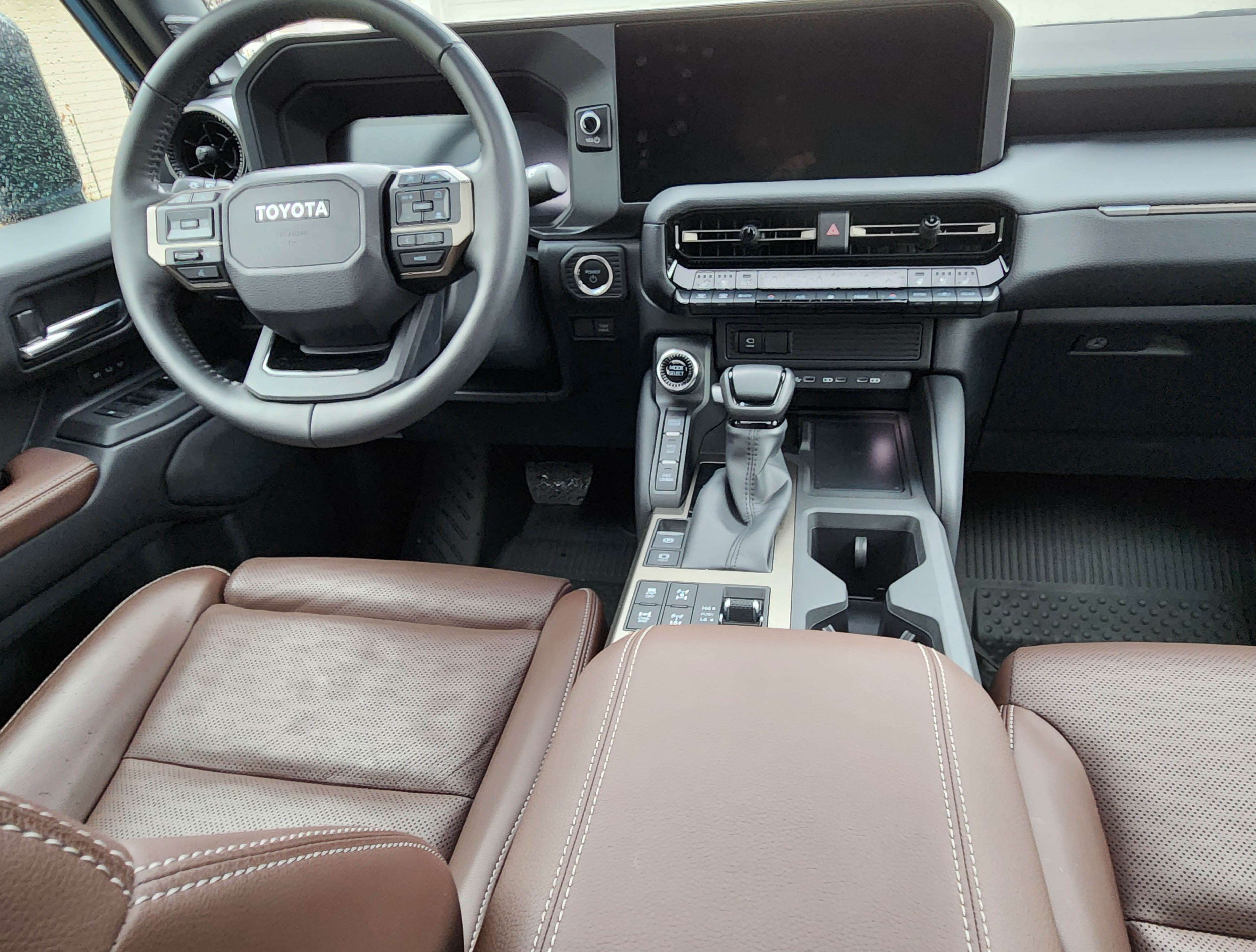
That’s handled via a dial on the console and other buttons there allow the differential to be locked and/or the sway bars to be disconnected for rock crawling, etc. Easy peasy!
Three drive modes also can be dialed in, so Eco to save gas, Normal and Sport to firm up steering and aid in low-end torque for faster getaways. You’d think Sport would be used a lot for more oomph in a 5,000-pound vehicle, but this doesn’t feel underpowered. Nope, this turbo is smooth and gutsy making acceleration surprisingly fast at 7.7 seconds from 0 to 60 says Car & Driver. Again, you’re in a mid-size SUV folks, so not bad at all.
Watch our Review Video: 2024 Toyota Land Cruiser review by Mark Savage and Paul Daniel
Also, check out a vintage Land Cruiser Car Spot: https://savageonwheels.com/2025/01/24/car-spot-1989-toyota-land-cruiser-fj60/
Yet it’s the handling that impresses most on a daily basis. Land Cruiser seems easy to maneuver in town and in parking lots despite its 193.8-inch length. The turning radius is moderate for a big truck making it relatively easy to slip into parking spaces and change lanes on the freeway. Even in heavy winds the Cruiser was extremely stable.
Ride too is well controlled so minor jiggles, no heavy butt thumps when traversing the Milwaukee street moonscape.
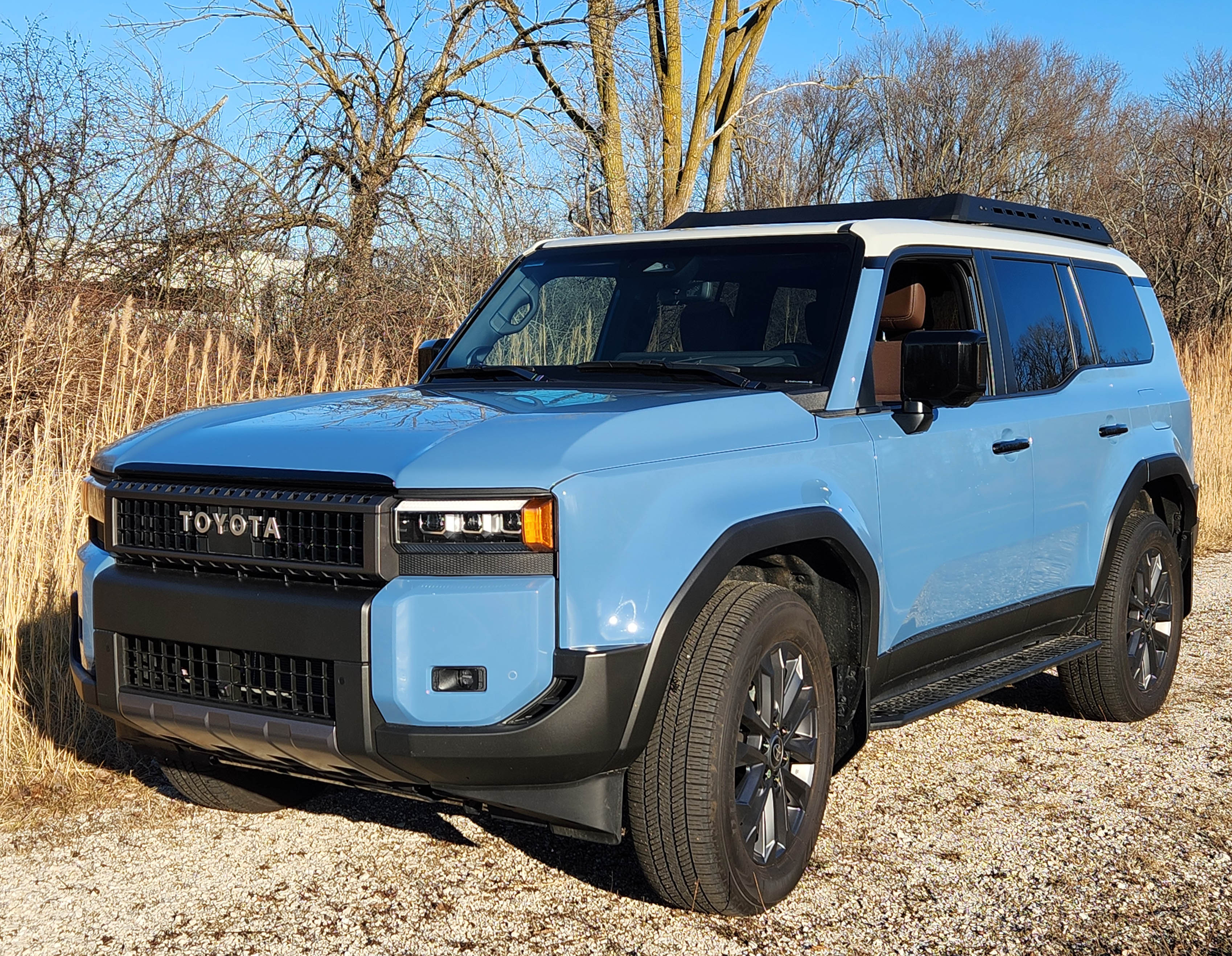
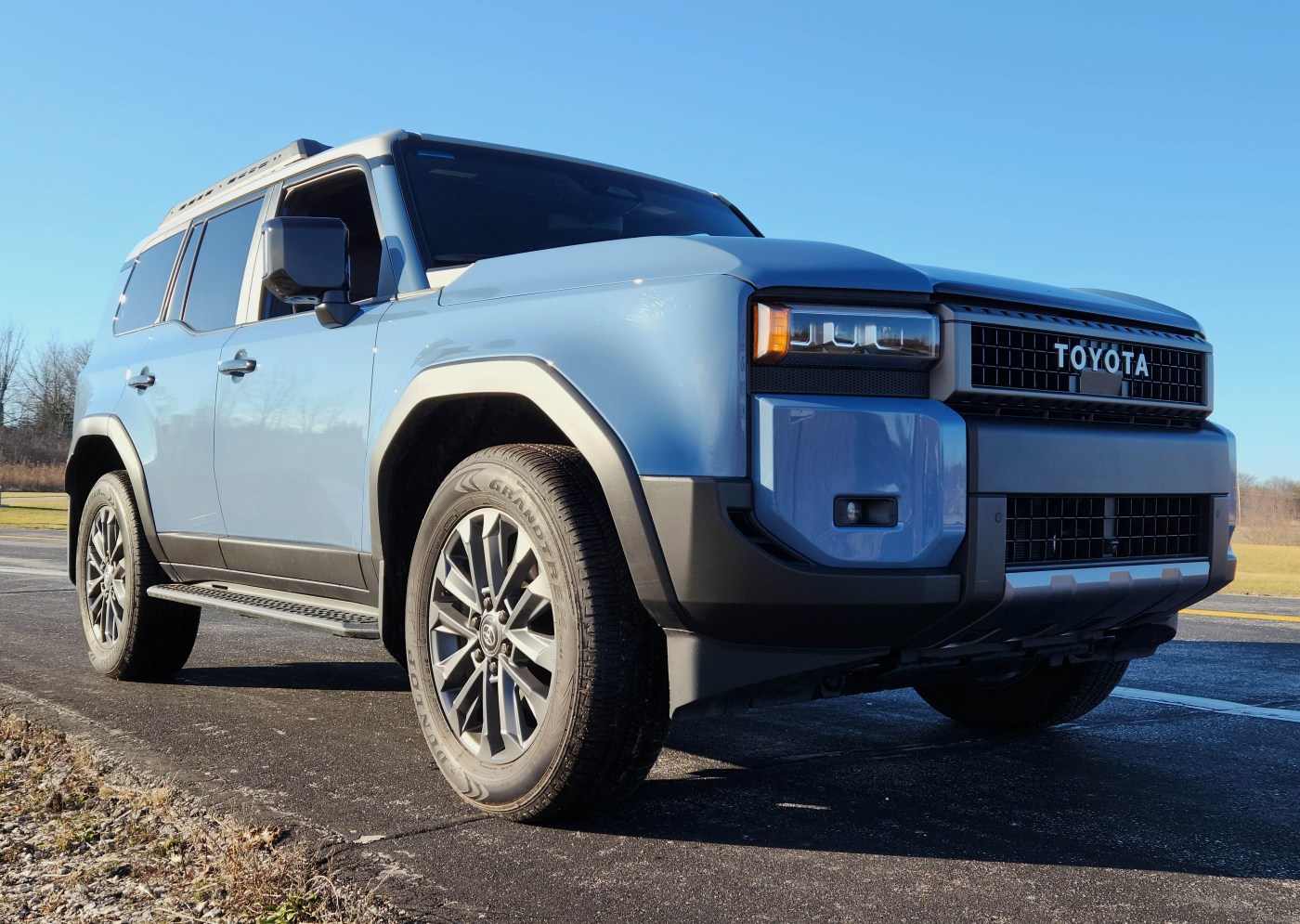
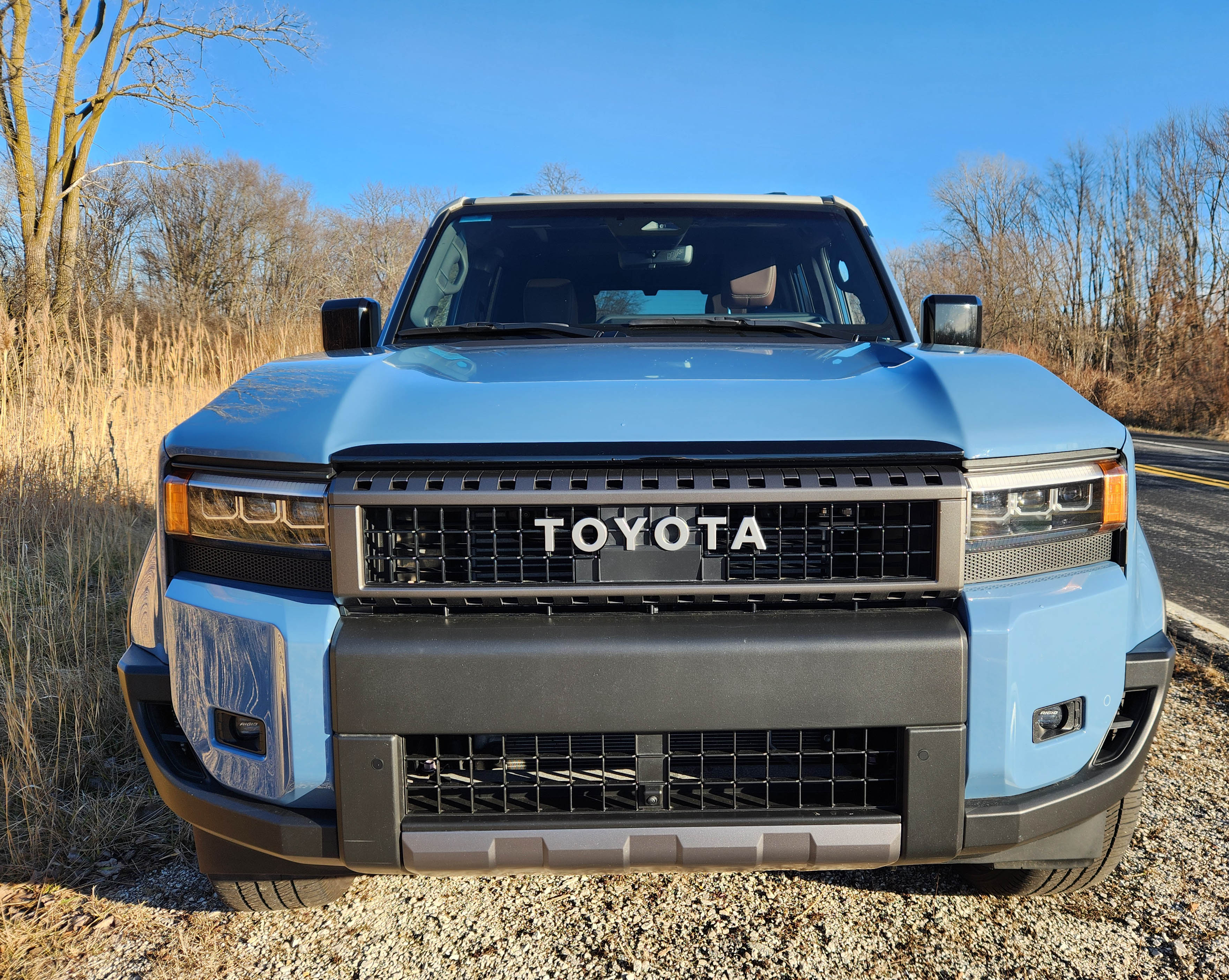
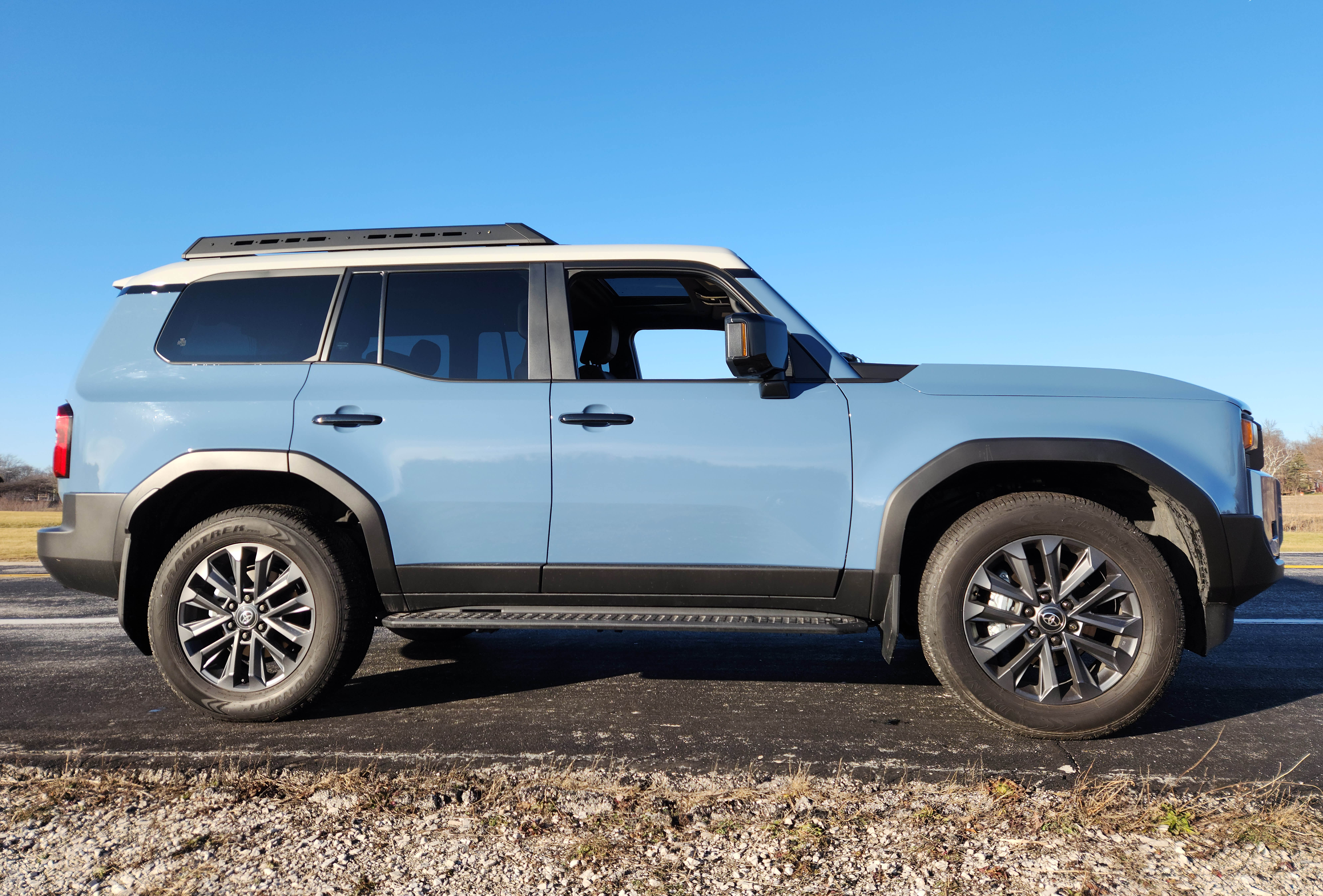
These new Cruiser looks are retro-mod too with squared off features nose and tail. This tester also touted a classy Smoky Blue (blue-gray) body with white roof, just $350 extra. Amazing, even to me, its looks actually garnered more positive comments than most of my past year’s test vehicles.
Inside though, it was more pedestrian, but still more modern than past models.

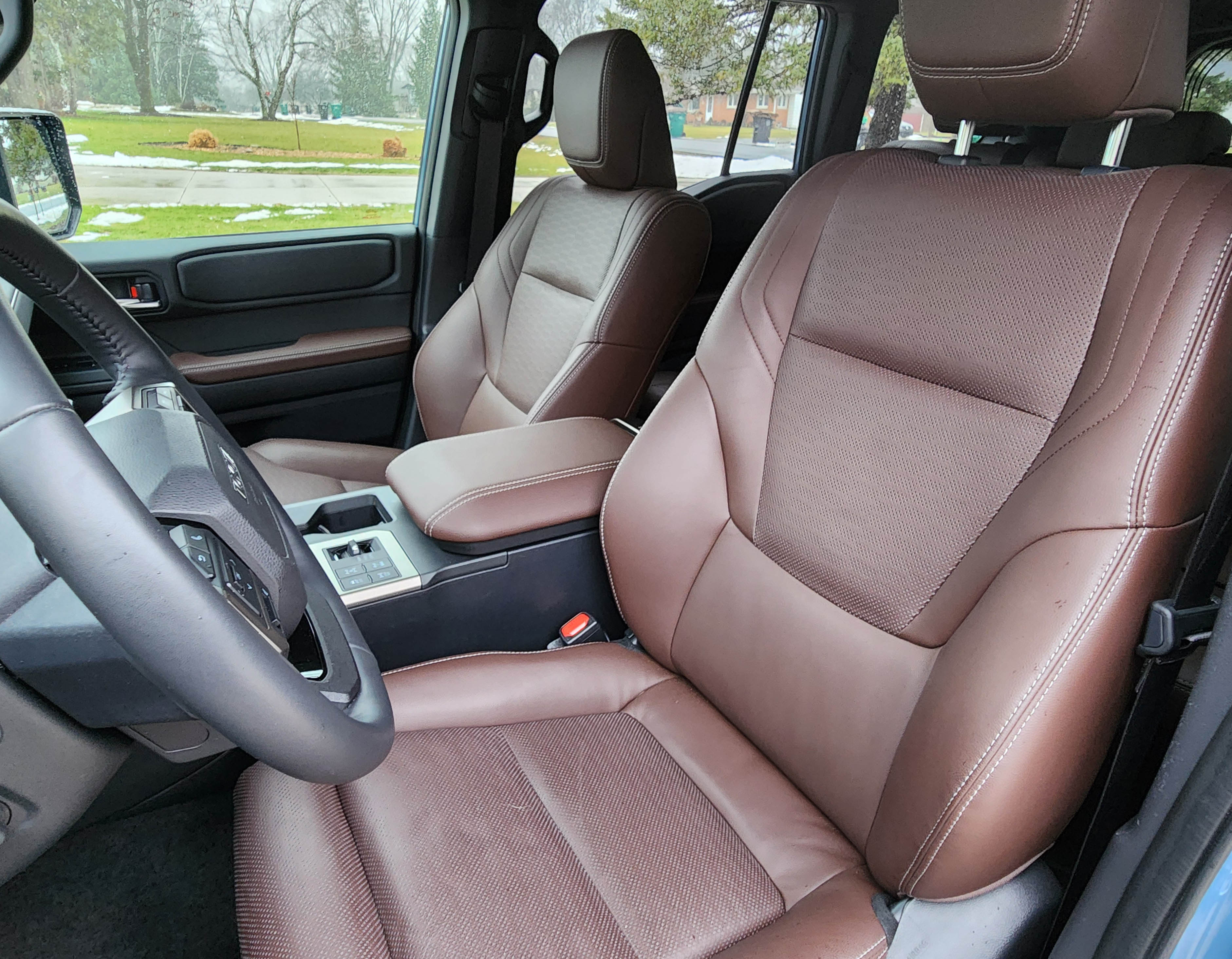
This one featured a chocolate brown leather interior with contrasting stitching, but a fair amount of hard plastic atop the dash and around the driver’s instrument cluster. Plus the sun visors were a hard plastic that did not fit the vehicle’s pricing. More on that in a sec.
Seating was comfortable, but just two rows in the Cruiser, unlike it’s cousin, the Lexus GX 550, which has three rows and is four inches longer than the Toyota. A third row is not even an option here.
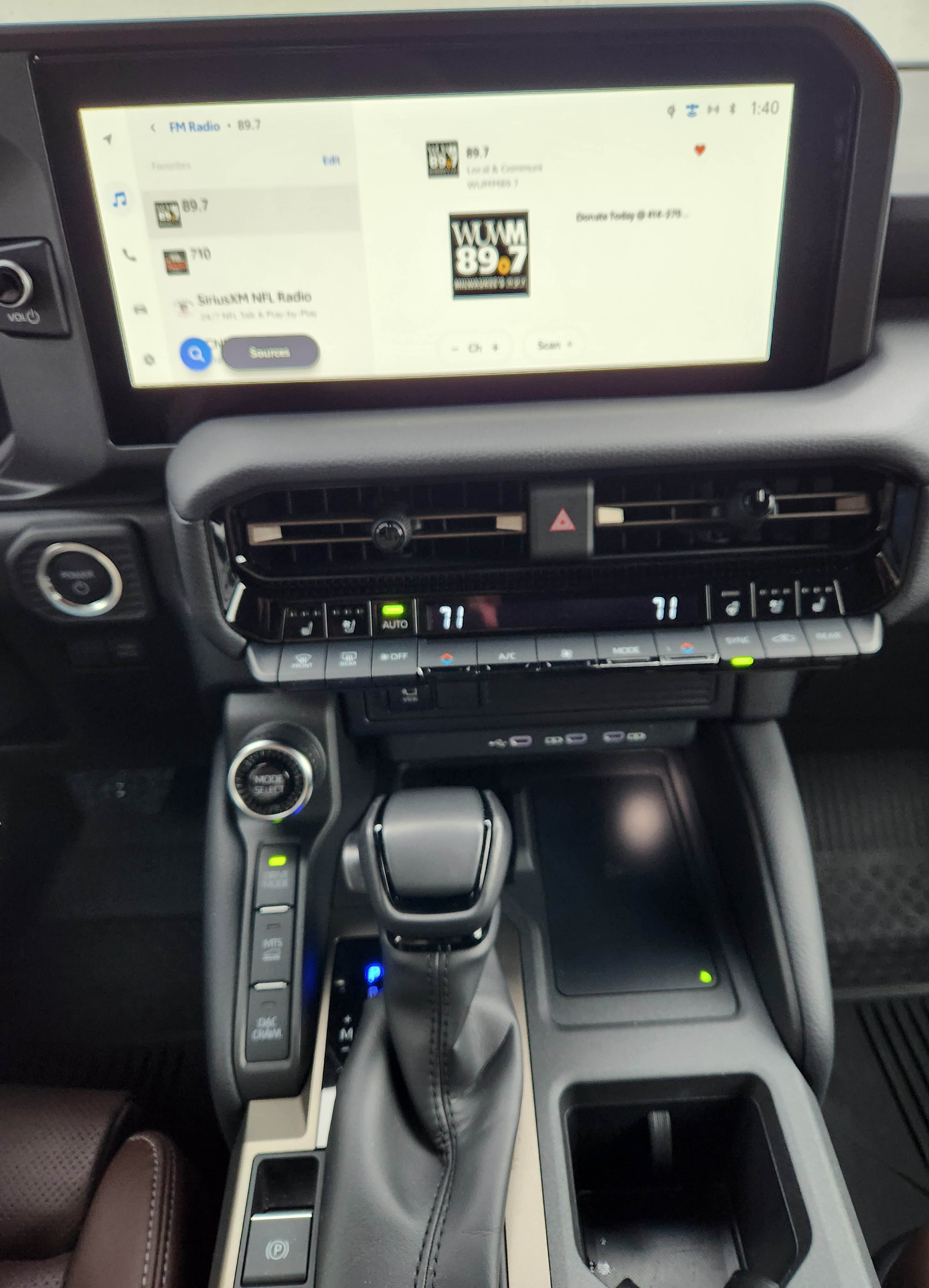
Naturally the dash has been updated with a 12.3-inch touchscreen that’s easy to use, plus the Toyota includes buttons and toggles below the screen to adjust the heated and cooled front seats, the heated steering wheel, and all the climate controls. The Lexus insists on all that being handled on its larger 14-inch screen. I prefer the buttons and toggles, and you will too, especially if you’re wearing gloves in winter!
Other pluses include a power tilt/telescope steering wheel and moderate-sized sunroof overhead. This one also had the optional wireless charger, plus a cool box in the console. Press a button and the storage container between the front seats will cool a beverage or keep a snack cool during a long drive.
The driver’s seat also powers back once the ignition is off, making it easier to extract oneself from behind the wheel. Running boards also are standard so climbing in and out is simple, also aided by copious amounts of grab handles by each door.
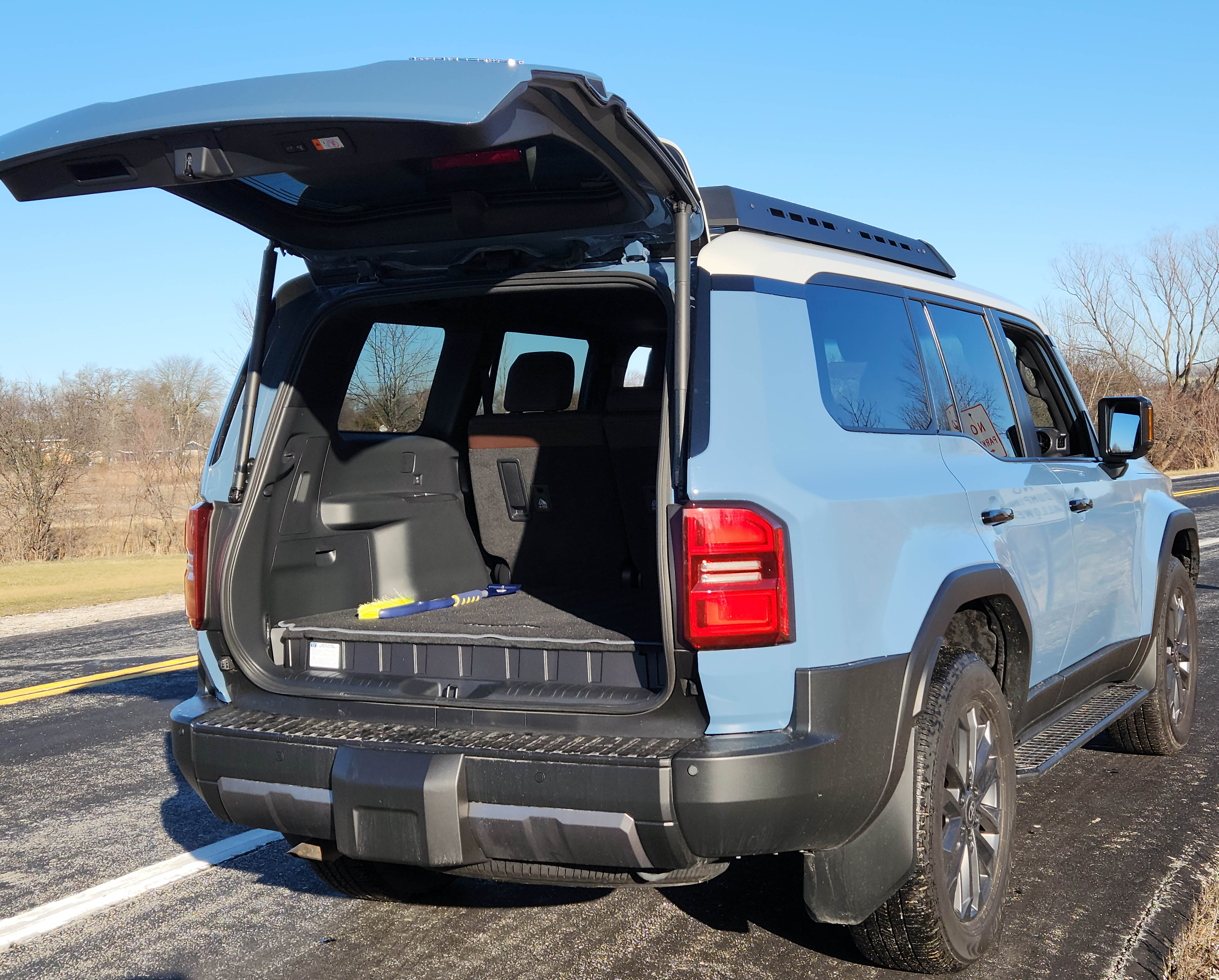
With no third row seats here the Cruiser provides a generous 37.5 cubic feet of cargo room under the power hatch, which is split. That means you can pop open the hatch’s window to load in cargo, or flip up the whole hatch. Fold the second row down and there’s a monster 82 cubic feet of storage room.
Note the cargo bed here is raised some, but seems easy enough to load and unload under the hatch.

Plenty of standard safety equipment on the Land Cruiser, but a little more is added via a $4,600 premium option package. That includes lane-change assist and front cross-traffic alert along with traffic jam assist. That cool box, wireless charger and a 14-speaker JBL sound system is part of that deal too. Likewise the power moonroof, leather-trimmed seats, a HUD, and digital rearview mirror complete the package.
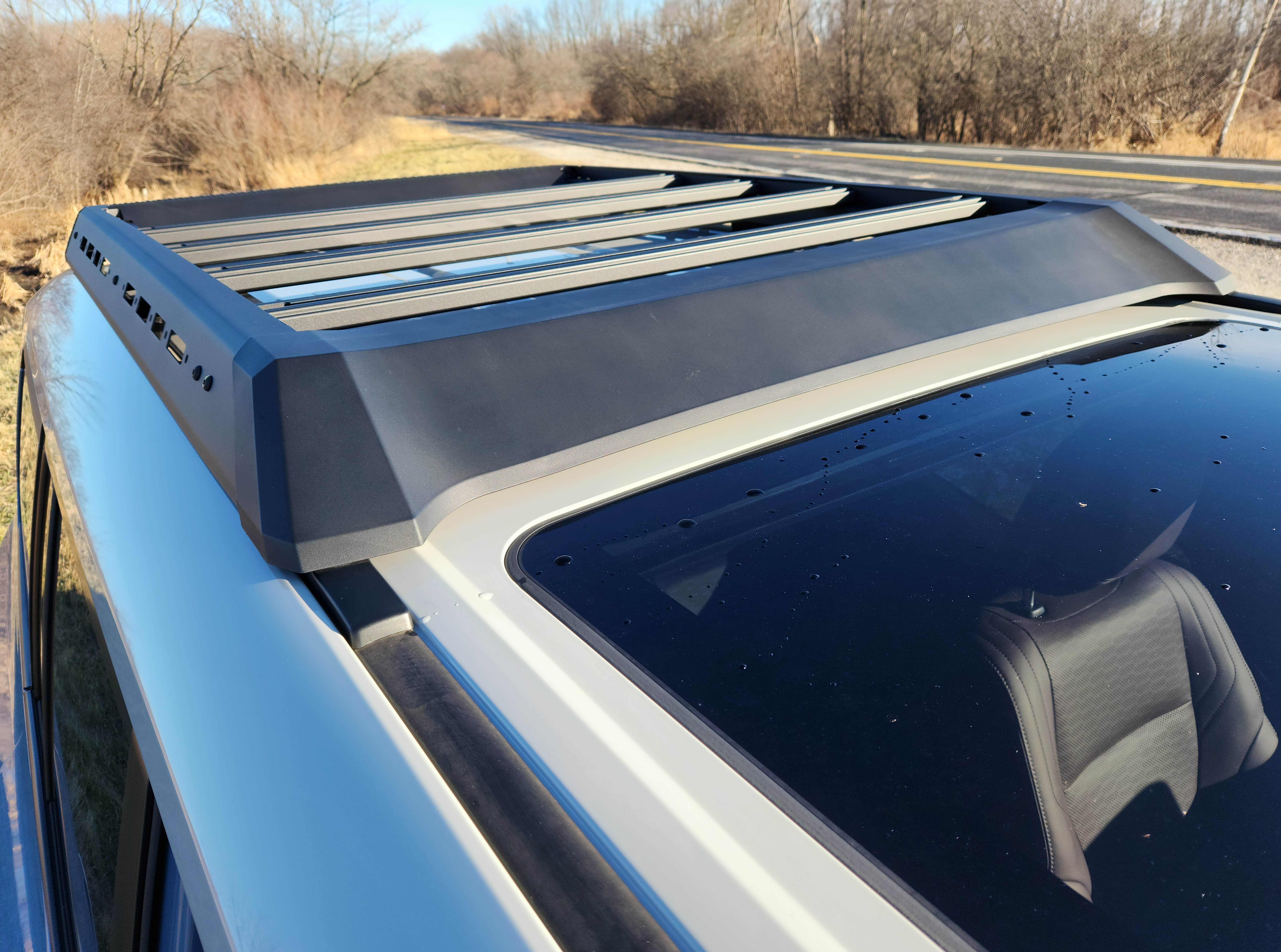
A roof rack adds to the Cruiser’s rugged looks, but also adds $1,440 to the price tag. The 20-inch alloy wheels add another $1,240. Ouch! Other options were minor.
One faux pas in an otherwise fine mid-size SUV, the overly complex driver instrument cluster. Oh, it looks fine, but to adjust it and get just something simple like the trip odometer to appear is an exercise in futility. Way too many choices. Be sure to complete any adjustments before driving.
Which brings us to price and a comparison with its cousin, the more luxurious 3-row Lexus GX 550.
The Toyota starts at just $57,345 for the base 1958 edition, named for when Toyota launched in the US market and sold just one Land Cruiser. That’s down from $87,000 for the base Cruiser in 2021, so a mega price drop after losing the V8 and allowing the Lexus GX 550 to top the pricing chart.
This tested Land Cruiser listed at $63,345, but ended up at $71,469, almost exactly the same as the Lexus GX 550 I tested last year. Yet the Lexus packs a twin-turbo 3.4-liter V6 that makes 349 horsepower and delivers 479 pound-feet of torque. It also will pull 8,000 pounds vs. 6,000 for the Land Cruiser.
Both prefer premium fuel.
Basically the Toyota runs about $5,000 less than the Lexus, which has a better looking interior and the larger engine and towing capacity. But if you intend to go off-roading, maybe go with this or the 1958 model and save the cash for fixing dents, dings and scrapes.
FAST STATS: 2024 Toyota Land Cruiser
Hits: Good smooth power, true off-road ability, nimble handling for big truck, AWD, well-cushioned ride, improved fuel economy. Big easy touchscreen, power tilt/telescope wheel, 3-level heated/cooled comfy front seats, heated wheel, sunroof, cool box, power hatch w/opening window, wireless charger, running boards, JBL audio, good safety equipment and towing features, 3 drive modes plus 5 off-road settings. Retro styling, multiple grab handles, and snazzy two-tone paint job.
Misses: Moderate size sunroof, no third row seat option, pedestrian interior styling, over-complex driver instrument cluster settings, hard-plastic sun visors.
Made in: Japan
Engine: 2.4-liter I-Force turbo I4, 326 hp/425 torque
Transmission: 8-speed automatic
Weight: 5,037 lbs.
Wheelbase: 112.2 in.
Length: 193.8 in.
Cargo: 37.5/82 cu.ft.
MPG: 22/25
MPG: 17 (tested)
Base Price: $63,345 (includes delivery)
Invoice: $58,390
Major Options:
20-in. alloy wheels, $1,240
Premium pkg. (14-speaker JBL audio, illuminated entry, digital key capable, power moonroof/shade, console cool box, digital rearview mirror, Qi-compatible wireless charging, leather-trimmed memory power driver’s seat, HUD, lane change assist, front cross-traffic alert, traffic jam assist), $4,600
Two-tone roof, $350

Roof rack, $1,440
Carpet cargo mat, $130
Carpet floor mats, $179
Ball mount, $80
Wheel locks, $105
Test vehicle: $71,469
Sources: Toyota, www.kbb.com
Photos: Mark Savage
 Savage On Wheels
Leave a comment