From when AMC was still rocking the pony car world
I’m a huge AMC geek, for those who don’t know it already, dad worked in the parts division for 27 years from 1963 to 1987. Those were fun times because he was always bringing fun stuff for me to drive after I got my license. Dad was a Nash guy before that so chances are I would have followed him right along. I especially like the late 60s to early 70s because they produced cars like this week’s spot, a 72 Javelin AMX.

American Motors entered the pony car wars a little later after Chrysler introduced the Barracuda, Chevy the Camaro, Pontiac the Firebird, and Mercury the Cougar. They tipped their hand in 66 with the Project IV cars which I still have the press kit from. On 22 August 1967, the Javelin was introduced with prices starting at $2,743. In typical AMC fashion, it was loaded with safety innovations such as interior windshield posts, the first industry use of fiberglass safety padding, and flush-mounted paddle-style door handles.

So it was safe and economical but let’s get to the fun part, horsepower. While two inline 6s were available, there were three V8s. A 290 with a two-barrel carburetor, 343 cu in two-barrel or high-compression premium-fuel four-barrel versions. Later a 390 was added. The 343, at 315 hp, combined with the “Go-Package” could do 0-60 in under 8 seconds. Plus, there were all kinds of day one adds in “Group 19” dealer-installed performance accessories such as dual four-barrel cross-ram intake manifolds, high-performance camshaft kits, needle-bearing roller rocker arms, and dual-point ignition to make the cars even faster. The total go package was just buying the two-door version, the AMX.
RELATED Spot: This is the car AMC hoped to fill the void, the Hornet
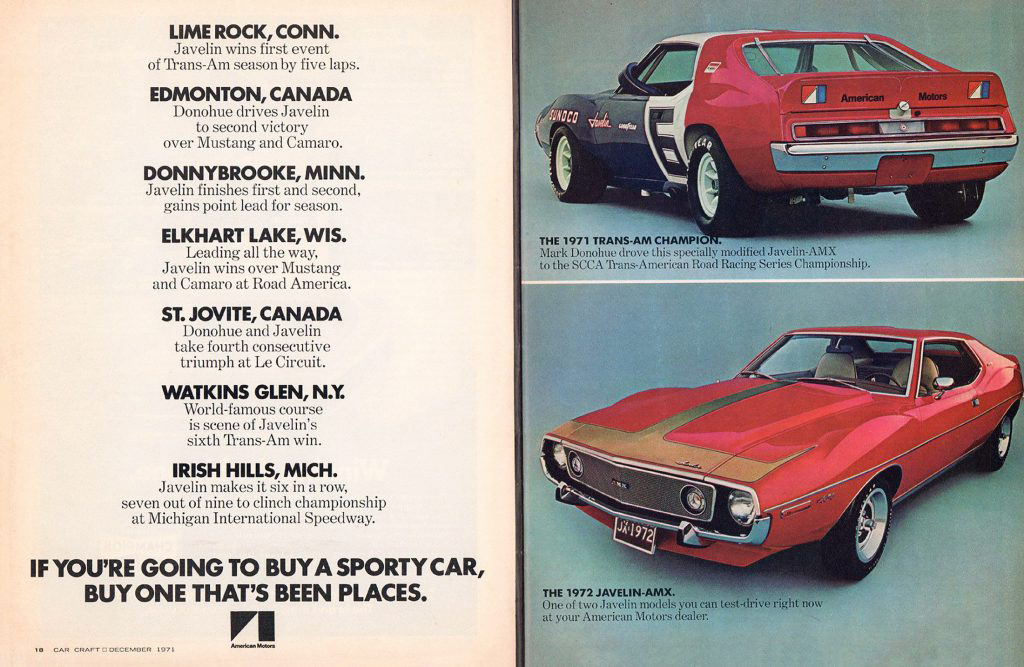
Thanks to a great marketing effort, I remember the “Hey Javelin” TV spot, dropped the average age of the early buyers to 29, ten years under the median for all AMC customers. And to show it was a legit performance car as much as the competition, the Javelins went racing in the Trans-Am series and won!

The automotive press loved the car. Car and Driver described the Javelin as having “a clean understated appearance that is not marred by phony vents, power bulges, mounds or bizarre sculpturing of whatever variety. The Javelin is an honest-looking car with a dramatic flair.” And while it didn’t sell the same volume as the competition, it did well for AMC with the best year, 1968 when just over 56,000 went out the door.
After a minor refresh in 1970, the second generation was introduced in 1971 but with the two-door AMX ending production, the name was carried over as a performance package. I liked the second gen which was noticeably different than its predecessor. I think designer Dick Teague did an outstanding job. AMC added a massive available 6.6-liter (401-cubic-inch) cranking out a whopping 330 hp and 425 lb-ft of torque.

Again, AMC took the Javelin racing and the year before had accomplished a marketing coup signing Rodger Penske and Mark Donohue for the 1970 season who immediately won with the car and again with the new one. There was excitement at AMC. I remember going to Road America for one of the races. The company had a tent at turn 14 to cheer Donohue on.

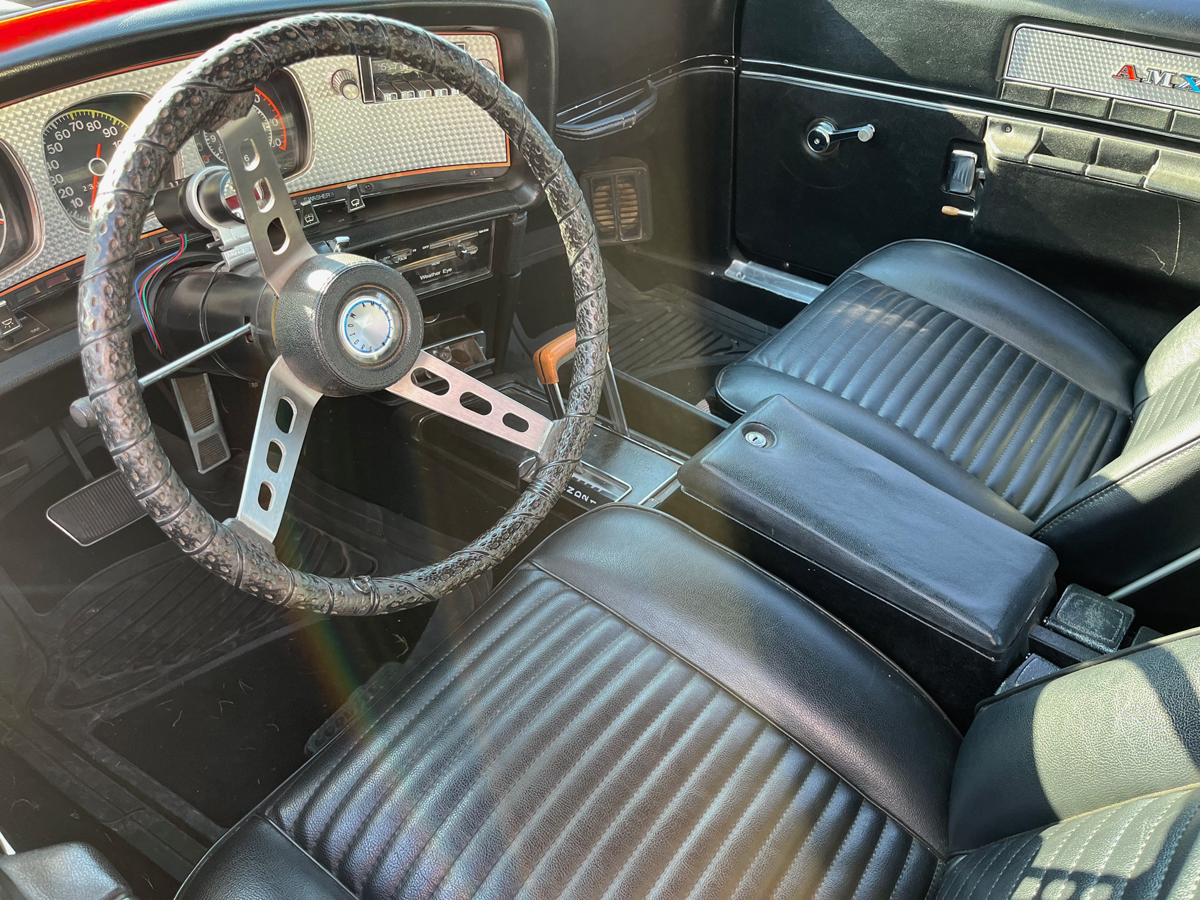
In 1971, of the ten races he participated in, Donohue won seven of them, the final six races in a row, and AMC won the Manufacturers’ championship for the first time ever. I was ecstatic! In the final race of the season, Javelins finished in first, second and third place, with George Follmer becoming the only other Javelin driver to win besides Donohue. I got to drive a 72 with the big V8 when dad brought one home for me to play with the weekend I graduated from high school. I loved the interior and the power that 401 kicked out.

Sadly, the “Win on Sunday, Sell on Monday” didn’t work for the Javelin with an average of 23,000 sold in 71-73. The 1974 Javelin was outsold massively by the new Camaro, Firebird, and the downsized Mustang II. Out of the final year, a total of 4,980 Javelin-AMX models were produced.
Sadly, that was all she wrote for the Javelin. There were a couple of items stacked against sales like a soft economy. There were also stricter bumper standards coming in 1975 which AMC estimated it would cost $12 million in engineering and design work. AMC produced a total of 227,610 Javelins from 1967 to 1974. So sad. The little company that could was essentially legislated out of the game.
RELATED Video: I’d love to have one of these but this is as close as it will get.
What are they worth now? Most of the last-gen Javelin AMX in Concours condition according to Hagerty can be had for around $50 grand although there were ones that sold for more at some auctions. This was one of the easiest spots for me to write about since I was there. Great memories. Thanks for stopping by and checking out this spot. Come back next Friday for another one along with some of its history and have a great weekend.
 Savage On Wheels
Leave a comment