The last year of big horsepower
I love muscle cars. There’s nothing like that rumble from the duel exhausts and smoke coming from a burnout. I especially love muscle cars where the top comes down like this week’s car spot.

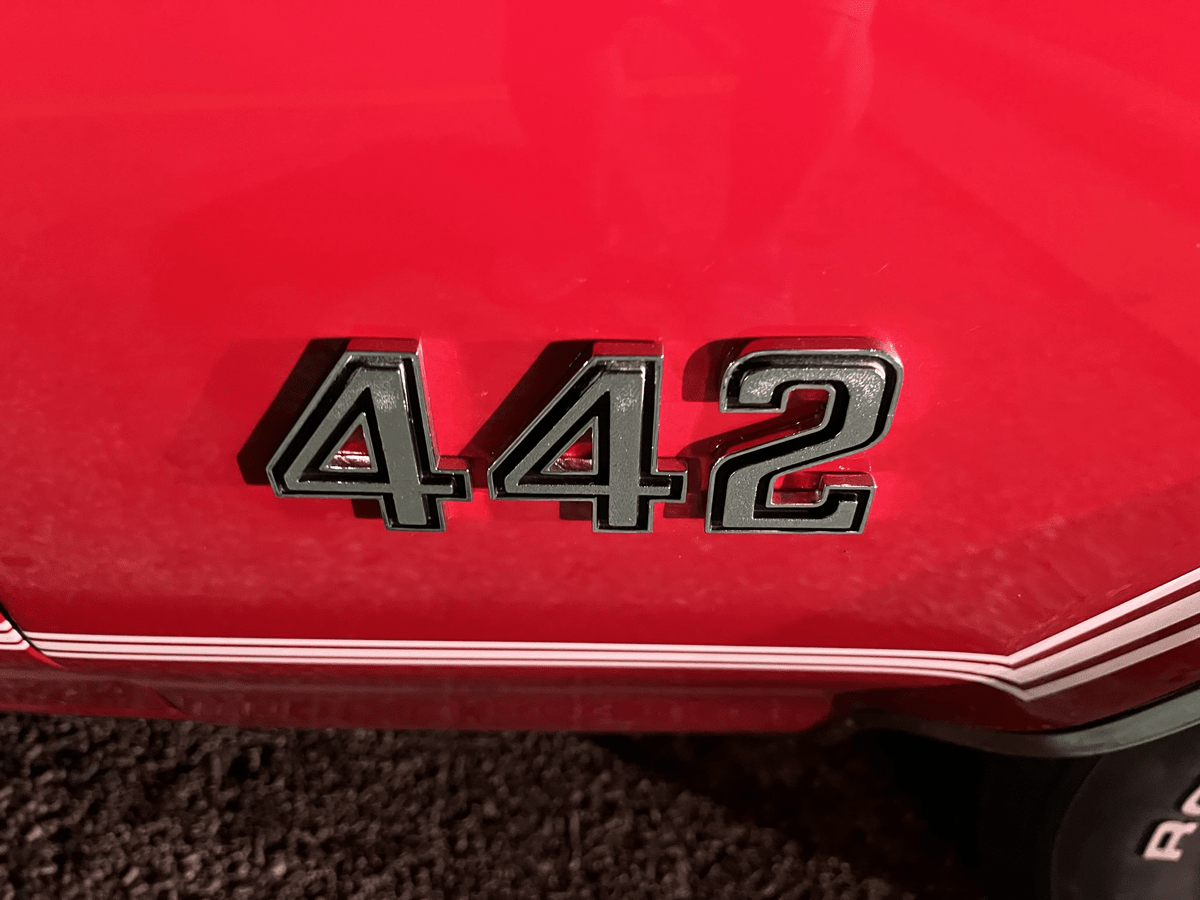
Introduced in 1964, when Oldsmobile was looking to create something to compete with the GTO. It got its name, “442,” from how it was built — a four-barrel carburetor with a four-speed manual transmission and dual exhausts. Introduced as an option package for F-85 and Cutlass models, it became a model from 1968 to 1971. Motor Trend tested an early 1964 4-4-2 with a 3:55 rear axle and ran 0–60 mph in 7.5 seconds, the standing quarter mile in 15.5 seconds at 90 mph and reached a top speed of 116 mph.


Many 4-4-2 enthusiasts see 1970 as the pinnacle of performance from Oldsmobile. A booming time for muscle cars as everybody was in the game. I love this era. General Motors dropped the cap on engine size and Oldsmobile responded by making the Olds 455 V8 the standard 4-4-2 engine. Output was 365 hp while a 370 hp variant was available with the W30 option.

The revised body style, and increased performance, was good enough to make the 4-4-2 pace car at the Indy 500 in 1970. A high-performance W-30 package was offered, which added a fiberglass hood (like this week’s example) with functional air scoops and low-restriction air cleaner, aluminum intake manifold, special camshaft, cylinder heads, distributor, and carburetor. Motor Trend tested a 4-4-2 W-30 with the four-speed manual transmission and 3.91:1 rear gears, clocking a quarter mile time of 14.2 seconds at 102 mph. The fun police (ie: EPA) came in and after 1970, that was about it for exciting 4-4-2’s. The last 4-4-2 rolled off the assembly line in 1991.

In 1970, Oldsmobile sold about 3,100 4-4-2s fitted with the W30 package. The Sports Coupe is the rarest of the bunch with only 262 units, while the convertible, like this one, is a close second with 264 examples. Because of the low numbers, and great performance, these command serious cash. According to Hagerty, in Fair condition, you can expect to pay $75 grand, Good, $115 grand, $160 grand for one in Excellent and $194 for a Concours example. A 4-speed, like this car has, will bump up the price by 20%. This car’s owner, who also told me she owns a 57 Tbird is one fortunate person owning a very important piece in automotive history.
Thanks for stopping by and check back next week for another one of my spots along with some history with it. Have a great weekend.
 Savage On Wheels
I agree with your article for the most part Paul, except for one point, the 442 pictured is a 1972 Olds 442, distinguishable by the headlights,grill, and taillights. Taillights in the 1970 were two vertical on both sides. The 1971 had two horizontal on both sides, and the 1972 is what you see here. The Pinnacle is the 1970 as mentioned, but the 71 declined to a respectable 350-hp, which was also the last model year for a 442, whereupon 1972 was reduced to a 442 trim and suspension package, and 455 w-30 was a mere 300-hp.
LikeLike
Hey thanks for the input.
LikeLike
Thanks so much Mike. Though it was a 70 but appreciate your catch. Would have been a fun car to take to Cars & Coffee.
LikeLike
I love your pick for this week, the car is a very special kind of Muscle Car. When I started on this “business”, I though the “442” was the size of the engine. LOL.
I do not think that 4-cylinder, front-wheel drive Olds from the 1980s/90s deserved the 442 badges, but we live in a world where Dodge minivans have the R/T nameplates on, so who am I to say something?
LikeLike