
Ford’s import fighter
There were a couple of things going on in the late 70s that kept the American auto manufacturers busy. One was the invasion of the market by cheap imports like the VW Beetle, Datsun 510, and Toyota MkII. The other thing going on, and the reason these cars sold so well, was the gas crisis in 1973, when prices were, get this, 39 cents! Add a zero to the end of that, and it’s about what we’re paying now. The Maverick was just one of the many subcompacts hitting the U.S. market, joining the Chevy Nova, Dodge Dart, Mercury Comet, and AMC Hornet.
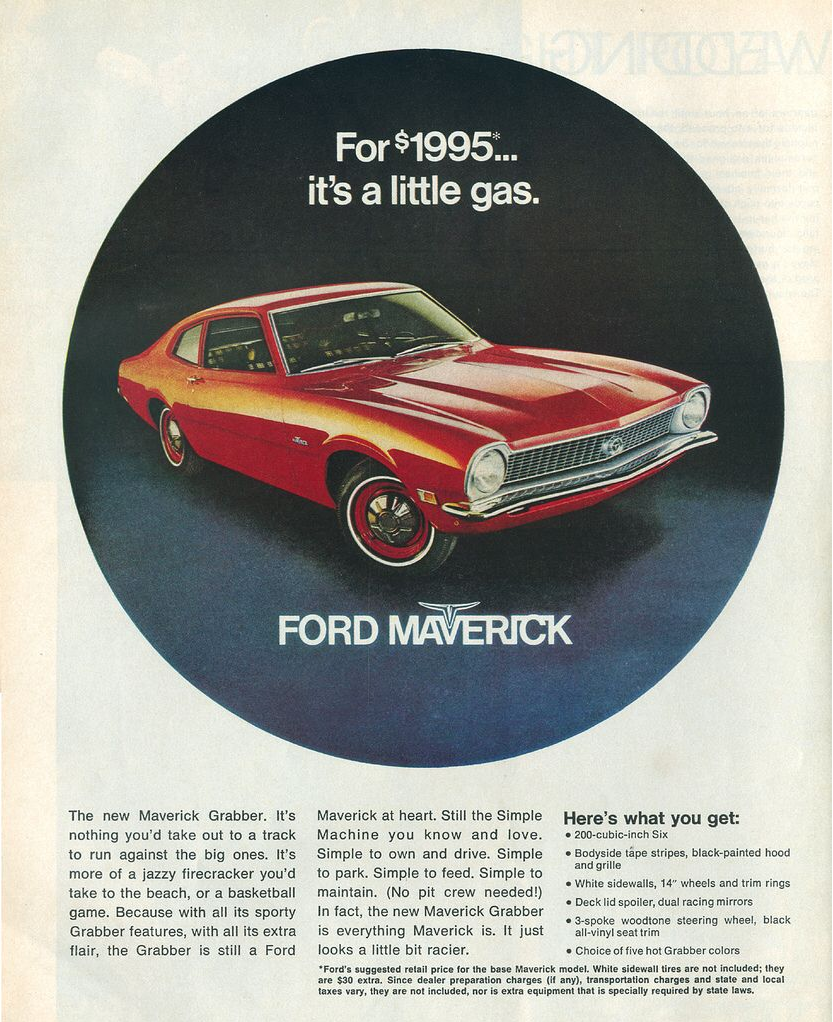
Introduced on April 17, 1969, as a 1970 model at just $1,995 ($19,151 in 2025 dollars). The TV commercials used the same music as the other Ford ads in the 1969 model year campaign, “Ford, it’s the going thing.” It replaced the Falcon and was available with inline-six engines or the more desirable 302 cubic-inch (5.0L) V8. Offered as both a two-door sedan and, for the first time in 1971, a four-door sedan. The 1971 model year brought the introduction of the Grabber, a sportier version with dual hood scoops and bold graphics. Inside, the low price point showed as much of it was made up of cheap plastics, and the early one didn’t even have a glove box. The Maverick’s styling featured the long hood, fastback roof, and short deck popularized by the Mustang, on a 103-inch wheelbase.

The car was a hit out of the gate in its first year, with nearly 579,000 Mavericks produced, approaching the record-setting first year of Mustang sales (nearly 619,000), and easily outpacing the Mustang’s sales of fewer than 200,000 in 1970. Total North American Maverick production reached 2.1 million units when the model was replaced by the equally crappy Ford Fairmont in 1977. I say this from experience, having driven them as news cars at two of the TV stations I worked at.
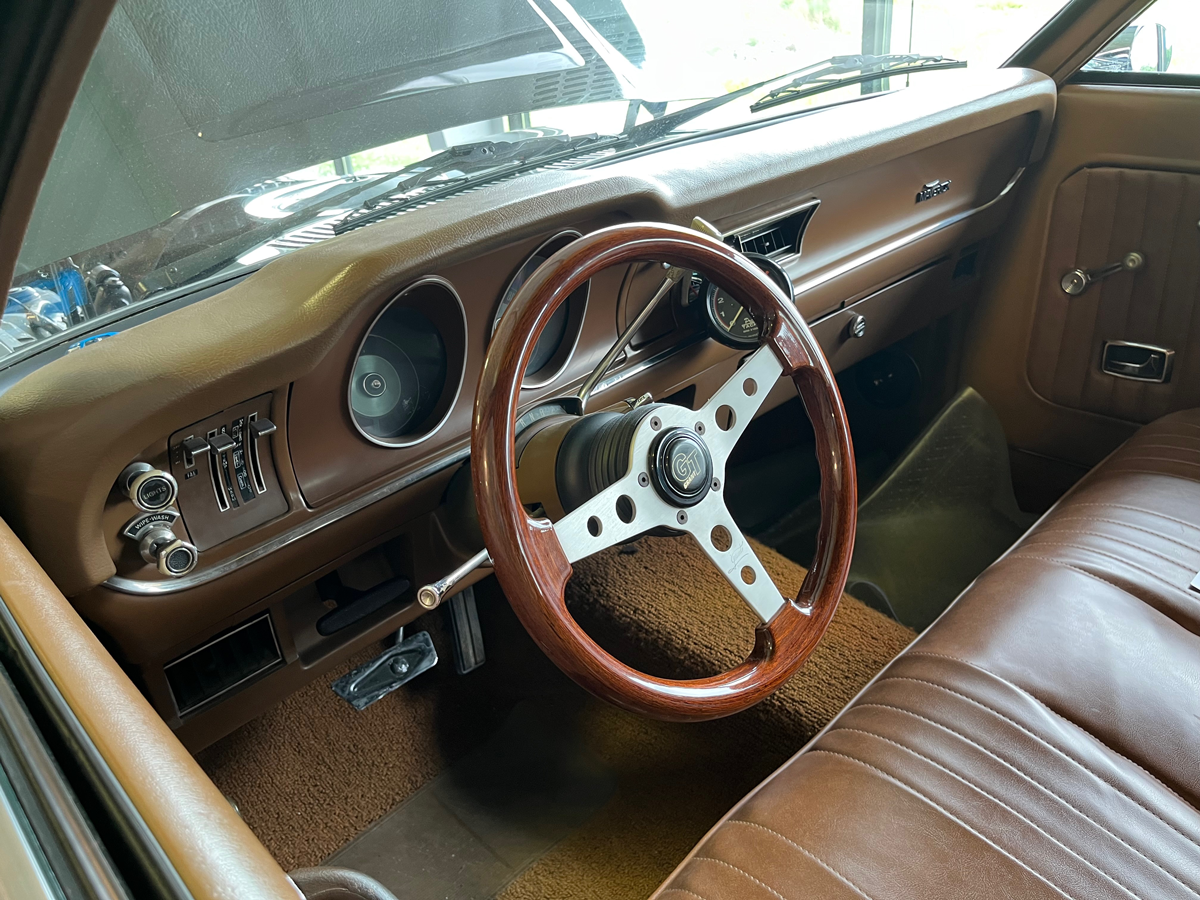
It was an “OK” car, but nowhere near a great car. While it handled nicely, early emissions equipment and rust were significant issues. Owners said that as a budget model, the Maverick was a “coarse, junky, economy car” with a basic interior and an emphasis on low cost over refinement. Build quality was also an issue, with many rusting out with low mileage. One of the few bright spots is that they were easily modified and up.

If you see one today, like this week’s spot, it is most likely that the owner had a connection with it originally. Sounds like…..me with AMC cars. They are cheap to own and easy to soup up like this one that I found at Art’s Auto Mart next to the National Corvette Museum in Bowling Green, KY.

Thanks for stopping by and checking out my latest find. Come back next week for another, along with some of its history, and have a great week ahead.
The simple, “bare-bones” nature of the car made it a popular platform for modifications, allowing owners to easily upgrade the engine and suspension
 Savage On Wheels
I always thought the Brazilian industry was similar to the Australian one.
LikeLiked by 1 person
I want to go to Australia just for that reason.
LikeLike
The base engine for the Maverick was the 170 CID (2.8 liter). Even if it was small for American standards, it was not what the customers needed to face the oil crisis. American automakers had one recipe for making cars, and they took way too long to learn a different way.
The consumers received the European and Japanese economy cars with open arms, and it opened a wound on the Big Three that never healed.
The Maverick was built in Brazil from 1973 to 1978. If you want to know about it, take a look at this article:
https://www.curbsideclassic.com/blog/international/cc-global-brazilian-maverick-from-deception-to-passion/
LikeLike
Just luv the stories about the Brazilian cars. Would be so cool to see some of that.
LikeLiked by 1 person
It was a very “romantic” period of our domestic auto-industry. It was a time when the gearheads were passionate for one brand or the other. Sadly, the newer generations don’t have all this love.
LikeLiked by 1 person